


The wait to build energy infrastructure in America has become a burden that falls squarely on consumers. That’s the blunt reality behind the recent, welcome news that Senate Democrats have agreed to reengage with Republicans on bipartisan permitting legislation. It’s long overdue.
Since taking office, the Trump administration has moved to expedite construction of energy projects through accelerated permitting — reducing time and costs and expanding Americans’ access to affordable, reliable energy. That’s a start. What’s needed now is legislation that locks in that progress and gives developers, investors, and communities the predictability they’ve been denied for years.
A modernized, efficient permitting process means fewer delays, more jobs, and lower costs for families and small businesses. It means people on fixed incomes can count on staying warm in January, and families who don’t have to choose between the heating bill and food or medicine.
More than 600 organizations — led by the U.S. Chamber of Commerce — have already signed a coalition letter to the full Senate urging passage of a more efficient federal permitting policy. The House has acted. The Senate should follow.
Here’s the problem in plain terms: the U.S. Hispanic Business Council reports that energy projects face an average approval time of nearly five years. That slow play costs an estimated $100 billion in lost investment. These aren’t abstract numbers — they represent projects that would have lowered your utility bill, created local jobs, and built the infrastructure a 21st-century economy requires.
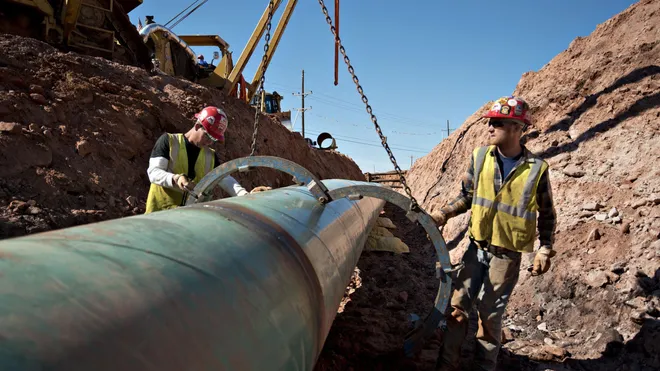
The casualties are well-documented. The PennEast pipeline — a 120-mile project designed to deliver natural gas from the Marcellus Shale to 5 million homes in Pennsylvania and New Jersey — was scrapped due to permitting paralysis. The Atlantic Coast Pipeline cancellation eliminated enough natural gas to serve 7.6 million homes. The Constitution Pipeline, which would have saved residents in New York, Massachusetts, Connecticut, and Rhode Island an estimated $165 million a year in energy costs, was canceled in 2020 after years of unwarranted regulatory battles — though it is now seeking revival.
The pattern is consistent and damaging: a functioning project, years of delay prompted by anti-business groups that seek to exploit every step of the process for delay, a death by a thousand regulatory cuts, and consumers who end up paying more for less.
This isn’t a federal problem alone. Even with strong federal reform, states that haven’t streamlined their own approval processes will continue to see projects stall. Reform at the state level — limiting facility siting boards to public service commissioners, setting guardrails on intervention by parties seeking to stop rather than shape projects — is just as essential. Stakeholders deserve to be heard. But the system cannot be a tool for a determined minority to block infrastructure that serves everyone.
The Northeast Supply Enhancement project, a 25-mile pipeline expansion through New York and New Jersey that would deliver enough Pennsylvania-produced natural gas for 2.3 million homes, is finally expected to move forward after its initial application was filed in 2017. Eight years. That’s not a permitting system. That’s a veto in slow motion.
Sensible reform doesn’t pick which energy sources get a streamlined, efficient permitting process – these are the rocks on which Congress has repeatedly crashed the permitting reform boat. Real reform will create a fair, thorough and easily navigable system that gives every viable project — gas, nuclear, transmission, renewables — a legitimate path forward on a defined timeline. The alternative is what we have now: a patchwork of local, state, and federal requirements that empower delay and punish investment.
America’s energy needs are growing. AI data centers, advanced manufacturing, and a rebounding industrial base are all driving demand that our current infrastructure was not built to meet. Building what’s needed requires predictable rules, enforceable timelines, and a system that recognizes energy infrastructure as the foundation of economic life — not a negotiating chip.
Every blocked project is a cost that eventually lands on a family’s energy bill. Every delayed pipeline is a winter of higher heating costs. The Senate has an opportunity to fix a system that has been broken for too long. The question is whether its members have the will to act — or whether they’d rather leave the bill with the rest of us.