

When winter storms sweep across the country, flight delays and cancellations feel inevitable. Snow, ice, and high winds are familiar travel headaches. But for millions of travelers stuck in terminals each winter, the real problem often goes far beyond the weather.
Behind the scenes, America’s aviation system depends on something most passengers never see: a reliable jet fuel delivery network. When that system is stretched or disrupted, even a modest winter storm can turn into days of cancellations, higher ticket prices, and widespread travel chaos.
That connection is the focus of Fueling Flight, a report from Consumer Energy Alliance that examines how jet fuel pipelines quietly support air travel reliability and affordability, especially during high-demand winter travel months.
You Don’t Think About Jet Fuel Until It Affects Your Trip
Jet fuel is invisible to most travelers, but its impact is immediate. As CEA’s Maddie Milam explained during a recent Action News 5 interview, when fuel infrastructure is constrained, consumers feel it right away through fewer flight options, higher prices, and longer disruptions.
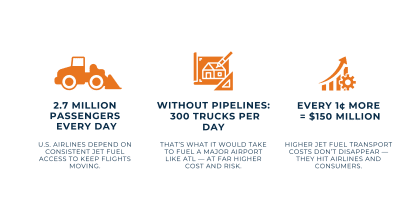
Every day, U.S. airlines operate roughly 27,000 flights, carrying about 2.7 million passengers. That scale leaves very little margin for error. In winter, when storms slow fuel deliveries and pipelines are already operating near capacity, even small disruptions can ripple across the system.
For travelers, that often means canceled flights instead of delays, packed rebooking lines, and sharply higher fares when seats become scarce.

Why Pipelines Matter Most During Winter Travel
Jet fuel pipelines are the backbone of air travel at large and mid-sized airports. They move enormous volumes of fuel safely, efficiently, and at a lower cost than alternatives like trucking or rail.
Much of that jet fuel begins as American-produced oil from the Gulf of America, one of the country’s most important energy-producing regions. That oil is refined into jet fuel and transported through pipelines that supply major airports across the country.
When those pipeline networks are constrained or delayed, the effects are felt far beyond the Gulf — showing up as canceled flights, higher ticket prices, and longer delays for travelers nationwide.
When pipelines are unavailable or constrained, airports must rely on trucks to deliver fuel over long distances. To put that into everyday terms, supplying a major airport like Atlanta without pipelines would require hundreds of fuel trucks driving more than 500 miles every single day. That is comparable to sending trucks from Tennessee to the Gulf Coast and back, nonstop, just to keep planes fueled.
In winter conditions, that kind of trucking is slower, more expensive, and far less reliable. Airports are not designed to handle that level of truck traffic, and delays compound quickly.
How Fuel Constraints Hit Your Wallet
Jet fuel is one of the largest cost’s airlines face, and increases show up quickly in ticket prices. Even a one-cent increase per gallon in fuel delivery costs adds roughly $150 million in expenses across the airline industry.
For consumers, that means fewer low-cost fares, higher average ticket prices, and less flexibility when flights are canceled and seats fill up. During winter travel, when weather already limits options, fuel constraints make it harder for airlines to recover and keep prices stable.
In practical terms, families pay more, travelers wait longer, and small businesses lose time and money when shipments are delayed.
When One Airport Has a Fuel Problem, Everyone Feels It
Fuel disruptions at major airports rarely stay local. Large hubs connect hundreds of cities, so when fuel supplies are tight in one region, delays and cancellations spread nationwide.
Milam emphasized that these disruptions affect more than passenger travel. Cargo slows, supply chains are disrupted, and communities that rely on aviation for jobs and economic activity feel the impact almost immediately.
Winter weather amplifies the problem by reducing backup options. When fuel cannot be delivered efficiently, airlines are forced to cancel flights outright rather than absorb short-term delays.
Demand Is Growing While Infrastructure Falls Behind
Air travel demand continues to grow, even outside traditional holiday peaks. Federal forecasts project significant passenger growth at large and mid-sized airports over the next decade.
While terminals and runways expand, jet fuel infrastructure is often aging and operating near capacity. Building or expanding pipelines takes years, which makes early planning critical. Delaying decisions today increases the likelihood of higher costs and more frequent disruptions tomorrow.
As Milam noted, slowing or blocking infrastructure projects does not reduce demand for air travel. It simply forces airlines to rely on less efficient, more expensive fuel delivery methods that consumers ultimately pay for.
What This Means for Travelers This Winter
Winter travel disruptions will always happen. Weather, congestion, and operational challenges are part of flying.
But travel disruptions caused by fuel constraints don’t have to be.
Reliable jet fuel pipelines help airlines recover faster from storms, limit cancellations, and prevent sharp price spikes when options are already limited.
Read the Fueling Flight report to see how strengthening jet fuel infrastructure can protect travelers from higher costs, delays, and winter travel chaos.