
Preparing Consumers Before the Storm
Hurricane season is here, and now is the time for families, businesses, and communities to make sure they are ready.
While the National Oceanic and Atmospheric Administration’s (NOAA) 2026 outlook projects a below-normal season, the agency also makes one thing clear: it only takes one storm to cause serious damage.
For consumers, hurricane readiness is not just about stocking up on supplies. It is also about understanding how storms can affect power reliability, fuel supply, transportation, food safety, and everyday household costs.
What This Means for You
Severe weather can disrupt the energy systems families and businesses depend on every day. High winds, flooding, storm surge, and debris can damage power lines, delay fuel deliveries, affect refineries and ports, and leave homes and businesses without electricity for hours or days.
The U.S. Energy Information Administration has reported that past hurricane seasons disrupted U.S. energy infrastructure, particularly across the Gulf Coast and Southeast. Those impacts were most visible in electricity markets, but storms also affected oil and natural gas production in the Gulf of Mexico.
That is why hurricane preparedness and energy preparedness go hand in hand.
The CDC recommends preparing before a storm by having:
- Emergency food and water
- Medicine and first-aid supplies
- Flashlights and extra batteries
- Important documents
- Safety supplies
- Emergency power sources
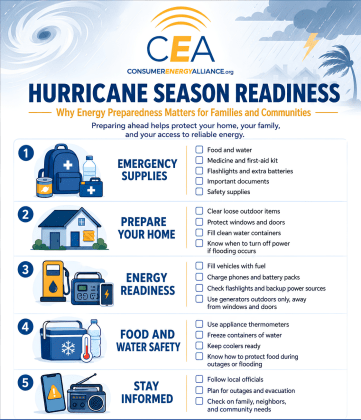
Families should also prepare their homes by clearing loose items from yards, protecting windows and doors, filling clean water containers, and knowing when to turn off power if flooding or evacuation becomes necessary.
Energy preparation also means thinking ahead. Before a storm, consumers should fill vehicles with fuel, charge phones and portable battery packs, check flashlights, and understand how to safely use generators. Generators should always be operated outside, away from windows and doors, to help prevent carbon monoxide poisoning.
Food and water safety should also be part of every household plan. The Food and Drug Administration advises families to prepare for outages by using appliance thermometers, freezing containers of water, keeping coolers available, and knowing how to protect food during flooding or power loss.
For businesses, preparation is just as important. Restaurants, grocery stores, gas stations, medical offices, and local retailers all rely on affordable, reliable energy to serve their communities. When power is disrupted, the effects can ripple quickly across local economies.
Planning Ahead Helps You Weather the Storm
Hurricane season is a reminder that energy is essential to safety, affordability, and everyday life.
Consumers can take practical steps now by preparing emergency supplies, planning for outages, protecting food and water, fueling vehicles, charging devices, and following guidance from local officials. At the same time, policymakers and energy leaders must continue supporting infrastructure investments that strengthen reliability before, during, and after severe weather.
Prepared communities are stronger communities. By planning ahead and supporting reliable energy systems, families and businesses can be better positioned to weather the storm and recover when it passes.